

The definition of industrial requirements and the numerical study of a structural node are among the results of the project’s initial phase, which is preparing new applications of metal additive manufacturing in large-scale components.
POÇO participated in defining the functional and industrial requirements of the MultiscaleDED project’s metal structures case study. The work formed part of the analysis and specification phase, completed in March 2026, and made it possible to establish a technical basis for developing components and structural connections through additive manufacturing processes.¹
The results of this phase include defining the needs of the application sectors, analysing deposition strategies, identifying candidate materials and specifying the case studies. In the field of metal structures, a numerical optimisation study of a tubular connection was also developed, identifying a promising configuration for further development.¹ ²
From industrial needs to the study of a structural connection
The metal structures case study focuses on a connection between tubular sections, representative of a truss node. The analysis addressed the connection geometry, load transfer, execution conditions and efficient use of material.²
One of the difficulties identified concerns the application of submerged arc deposition on curved surfaces. In this process, the granular welding flux must remain in the deposition area, meaning that the component geometry and its orientation affect the stability and feasibility of manufacturing.²
To address this limitation, a connection configuration between three circular tubular sections was proposed. This geometry served as the basis for a topology optimisation study of the node’s central region, with a view to making it compatible with a hybrid additive manufacturing strategy.²
Topology optimisation makes it possible to study the distribution of material within a defined domain according to the loads and constraints considered. It is a structural design approach that seeks to identify geometries suited to performance objectives and may incorporate volume limitations and other design requirements.³
A promising configuration identified through simulation
The numerical study presented in the project documentation was carried out in Abaqus, considering the solid region of the node as the optimisation domain. Different volume constraints were analysed, seeking to minimise strain energy under the loading and support conditions defined in the model.²
Among the configurations evaluated, the solution corresponding to a volume fraction close to 40% was identified as the most promising for further development. This value refers to the amount of material allowed in the numerical optimisation domain; it does not represent a weight reduction already demonstrated in a manufactured component or a complete structure.²
The study also identified the need for additional re-engineering and shape optimisation stages intended to smooth the geometry, reduce stress concentrations and prepare the component for manufacturing. The result achieved is therefore a reference numerical configuration, still subject to refinement and subsequent experimental validation.²
Three deposition processes, a multiscale approach
In parallel with the case studies, the consortium completed the analysis of manufacturing strategies and the complementarity between three metal deposition processes. The defined approach associates submerged arc deposition, WAAM-SAW, with high-volume regions; the WAAM-GMAW process, based on a gas-shielded electric arc, with medium-sized components and regions; and laser deposition, LMD, with areas requiring greater detail, coating or precision.¹
This distribution seeks to reconcile productivity, geometric flexibility and precision according to the needs of each region of the component. In the scientific literature, wire arc additive manufacturing is identified as an approach with potential for medium- and large-scale metal components because of its deposition rates and the possibility of reducing material waste compared with certain conventional manufacturing routes.⁴
In MultiscaleDED, the result of this phase was the definition of the functional architecture and preliminary integration requirements. Requirements were specified for flux feeding, containment and recovery, automatic interlayer slag removal, active cooling, path generation and process monitoring. The physical integration and validation of the platform remained to be completed at the end of the period covered by the report.¹
Materials, thermal control and validation criteria
The work included identifying candidate material families, namely carbon and structural steels, stainless steels and aluminium alloys, according to the applications considered in the project. The relationships between deposition parameters, thermal cycles, geometry, microstructure and mechanical properties were analysed, as were the requirements for producing materials with differentiated properties in specific regions of the component.¹
This link between process, metallurgical structure and properties is also a central topic of international research into metal additive manufacturing. The literature highlights the need to understand the physical and metallurgical mechanisms involved in order to guide material selection and the development of manufacturing conditions.⁵
For the case studies, the functions of the components, service conditions, relevant failure modes, post-processing needs and preliminary inspection and validation criteria were identified. POÇO contributed specifically to defining the functional and industrial requirements of the metal structures, while Universidade de Coimbra carried out the technical and scientific analysis of the processes, materials and optimisation methods.¹
Results that guide the next stages
The analysis and specification phase produced three technical deliverables: a report on manufacturing strategies and analysis of deposition processes; a report on materials and requirements for functional gradients; and a report specifying the case studies in moulds and tools, metal structures, and maritime and naval components. The milestones relating to the definition of the scientific and technological challenges and the detailed definition of the case studies were also completed.¹
These results establish the basis for developing the subsystems, refining the geometries, preparing the demonstrators and subsequently evaluating the solutions experimentally. At this stage, the documented advances lie in technical specification, the definition of industrial applications and numerical study, and do not yet constitute a demonstration of the performance of final components.¹ ²
POÇO’s participation made it possible to integrate the needs of metal structures into the consortium’s research work, helping to direct technological development towards specific industrial applications.¹
About the project
MultiscaleDED is led by AGIX and brings together POÇO, PENIMAR, Plácido Roque, Universidade de Coimbra, SEAPOWER and Incentahead. The project is scheduled to run from 1 July 2025 to 30 June 2028, with operation code COMPETE2030-FEDER-02304300.¹
Project co-funded by the European Union under COMPETE 2030 and Portugal 2030.
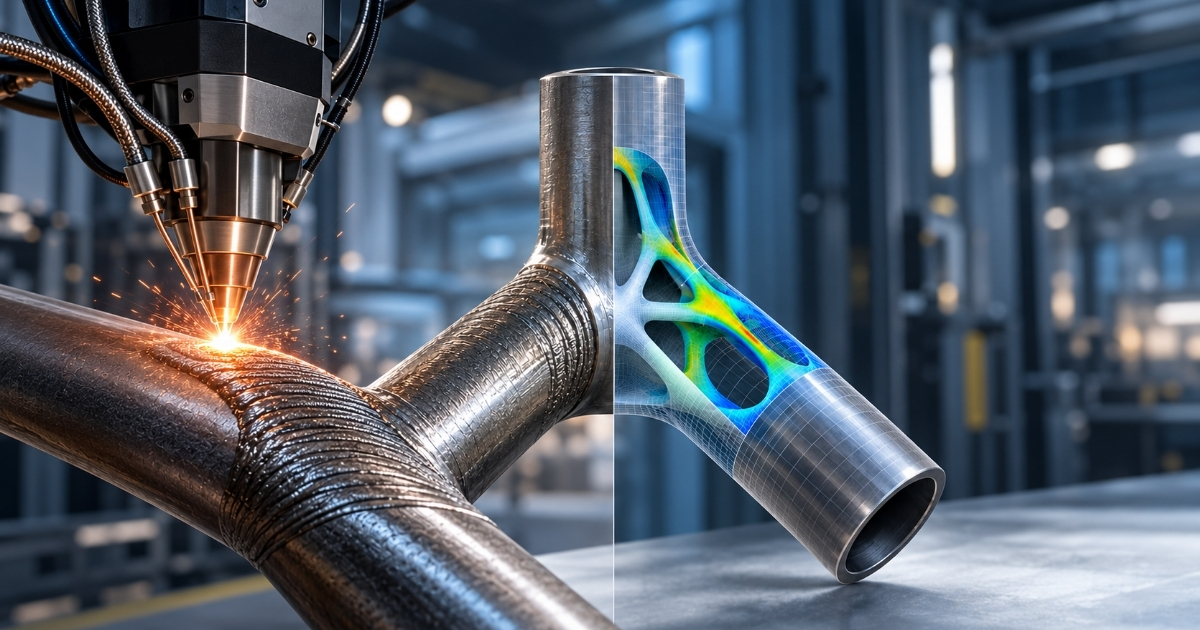
Digitally generated illustrative image: conceptual representation of metal additive manufacturing and structural optimisation. It does not correspond to a manufactured prototype or a project simulation result.
Notes and references
¹ Project documentation. Consórcio MultiscaleDED. 1.º Relatório Técnico-Científico Anual — período de 01/07/2025 a 30/06/2026. Documento RTC-S2-A1_MultiDED_VF, 2026, pp. 4–12 e 18–21.
² Structural case study. Consórcio MultiscaleDED. Entregável E1.3 — Relatório do estado da arte, desafios e definição das especificações técnicas e funcionais para os casos de estudo em tooling, estruturas metálicas e componentes marítimos/navais. 2026, secção 4.2, pp. 33–37 do entregável.
³ Topology optimisation. Sigmund, O.; Maute, K. “Topology optimization approaches: A comparative review”. Structural and Multidisciplinary Optimization, 48(6), 1031–1055, 2013. DOI: 10.1007/s00158-013-0978-6.
⁴ Wire arc additive manufacturing. Williams, S. W.; Martina, F.; Addison, A. C.; Ding, J.; Pardal, G.; Colegrove, P. “Wire + Arc Additive Manufacturing”. Materials Science and Technology, 32(7), 641–647, 2016. DOI: 10.1179/1743284715Y.0000000073.
⁵ Processes, materials and properties. DebRoy, T.; Wei, H. L.; Zuback, J. S.; Mukherjee, T.; Elmer, J. W.; Milewski, J. O.; Beese, A. M.; Wilson-Heid, A.; De, A.; Zhang, W. “Additive manufacturing of metallic components — Process, structure and properties”. Progress in Materials Science, 92, 112–224, 2018. DOI: 10.1016